The MEDDIC Sales Process – By Darius Lahoutifard | MEDDIC Academy [initially published in January 2021, updated in June 2026] This article explores the MEDDIC Sales Process and its application in today’s sales landscape.
Yes, I wrote MEDDIC Sales Process, and I meant it
Let me be upfront about something. In our Introduction to MEDDIC course, I teach that there is no such thing as the MEDDIC sales process. MEDDIC, and its evolved form, MEDDPICC®, is a sales methodology, not a sales process. It is process-agnostic: it overlays on top of whatever sales process your organization already uses.
A mature, growing business has usually figured out its winning sales process and should integrate MEDDIC into that existing process. Early-stage startups and smaller businesses experimenting with different approaches can use what follows as a starting process.
So why does this post exist? Because every week, I get the same question from course attendees.
The question every rep eventually asks
“This is all great. But where do I start?”
Or: “In which order should I apply the elements of MEDDIC?”
Or: “Where does the MEDDIC Sales Process begin, and where does it end?”
These questions come most often from junior reps, but senior reps ask them too. And they are completely legitimate. The MEDDIC elements are a checklist , not a rigid sequence, but in practice, experienced reps do tend to execute certain steps before others. There is a logical, battle-tested flow that emerges when you map MEDDIC onto the arc of a complex B2B sales campaign.
That’s what this post is: a typical MEDDIC sales process — the sequence that makes the most sense for most complex sales, most of the time. A default playbook, not a rigid script.
MEDDIC vs. MEDDPICC®: a quick clarification
MEDDIC is the original six-element framework: Metrics, Economic Buyer, Decision Criteria, Decision Process, Identify Pain, Champion. It was born at PTC (Parametric Technology Corporation) in the 1990s, where it helped an enterprise sales team bring structure, predictability, and repeatability to some of the most complex B2B deals in the software industry.
MEDDPICC® is the evolved version, developed and trademarked by MEDDIC Academy. It adds Paper Process and Competition — two elements critical in modern enterprise sales that were often treated as afterthoughts in the original framework.
Throughout this post, when I refer to “the MEDDIC sales process,” I mean the full MEDDPICC® framework. MEDDPICC® is a registered trademark owned by Darius Lahoutifard, used by MEDDIC Academy under exclusive authorization.
Is MEDDIC / MEDDPICC® a checklist, a framework, a methodology, or just an acronym?
There is an ongoing debate in sales circles about how to categorize MEDDIC. Some call it a checklist. Some call it a framework. Others call it a methodology. A few treat it as little more than a memorable acronym. All of these perspectives contain a grain of truth, and all of them underestimate what MEDDIC actually is when practiced at a high level.
Here is the most important thing to understand: the acronym itself, Metrics, Economic Buyer, Decision Criteria, Decision Process, Identify Pain, Champion, represents roughly 15% of what a skilled MEDDIC practitioner actually does. The letters give you checkpoints on the map. They neither give you the territory, nor the road. What the 21 stages in this post make visible is everything that lives beneath the surface of those six words: how you develop a Champion versus merely identifying one, how you test whether your Champion is real, how you influence Decision Criteria rather than just document them, how you turn a proof of value into a ceremony rather than a gamble, how you build the urgency that makes a close feel inevitable rather than forced. That is the methodology. That is what separates reps who know the acronym from reps who can actually execute.
How about a typical sales process ?
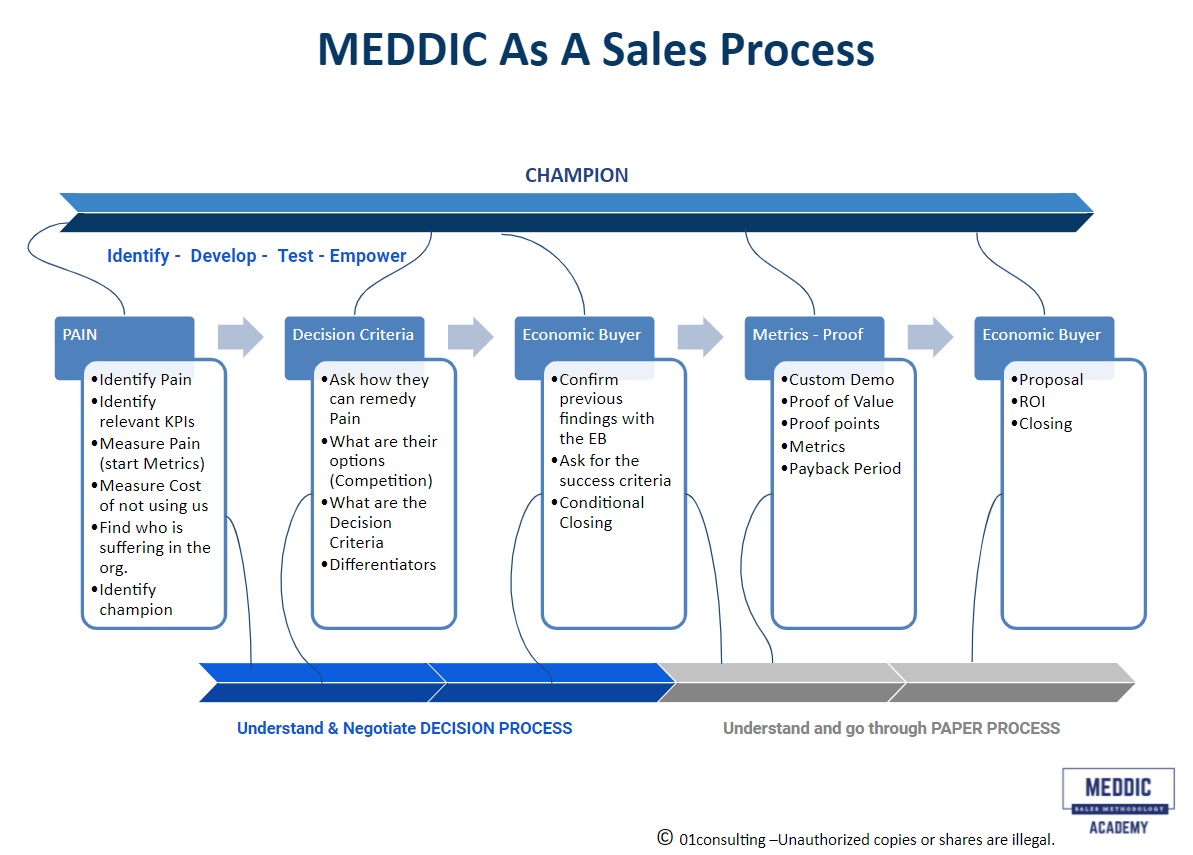
“Typical”, yes that’s the word. Another way to look at the sales stages within the framework of MEDDIC is considering a “typical” MEDDIC sales process. Companies have different sales processes, yet we all expect it to be close to the typical process we have in mind. For instance, the chart below is considered as one of the most typical sales process charts.

The above chart is a typical sales process everyone in sales would admit; even though everyone may use a slightly different language with slightly different stages.
In a similar way, what is the typical sales process, when using the MEDDIC sales methodology?
Here’s the answer:
The stages of a typical MEDDIC sales process
What follows is the typical sequence of actions in a complex B2B sales campaign run within the MEDDIC / MEDDPICC® framework. Each stage includes the why behind it, not just the what. For the full depth of execution, the techniques, plays, and coaching behind each step, you need at a minimum the Full MEDDPICC® course or better, the Advanced MEDDPICC followed by one of our live workshops.
Stage 1 — Identify the pain or goals
Everything begins here. Not with your product. Not with your pitch. Not with your slides. You start by uncovering what is broken, what is costing them, or what strategic outcome they are trying to reach. Pain and goals are two sides of the same coin: a pain is an unresolved problem with a real cost; a goal is a future state with a real benefit. Both are valid entry points into a MEDDIC sales campaign.
Stage 2 — Identify potential champion candidates
This happens in parallel with Stage 1. From the very first conversation, you are already asking yourself: who in this organization is most impacted by this pain? Who stands to gain the most from solving it? Those are your Champion candidates, because their personal win is obvious. And depending on their level of financial authority, they may even turn out to be your Economic Buyer. The pain and the people are inseparable; which is why these two stages run simultaneously even though they are distinct disciplines.
Stage 3 — Quantify the pain: start building metrics
Unquantified pain is just a conversation. Quantified pain is a deal.
As soon as pain is identified, start quantifying it. What does it cost them today; in lost revenue, wasted time, compliance exposure, customer churn? The number doesn’t have to be exact at this stage, but it has to exist. This is where your Metrics work begins, and it will pay dividends all the way through to the ROI pitch at the close.
Stage 4 — Identify who in the organization is suffering
Pain that lives in one person’s world rarely drives a purchase decision. Map the organizational impact: which teams, which functions, which leaders are affected when this problem goes unsolved?
This step is also a filter. Do not waste time with people who are not suffering from the pain. Those individuals, regardless of their title, are often gatekeepers. At best, they are coaches. They may be in regular contact with you, engaged in your calls, and appear helpful. But if they are not personally affected by the pain, they cannot be your Champion, and they will not move the deal forward strongly when needed.
The people who are suffering, based on their level of financial authority, will become either your Champion or your Economic Buyer.
Stage 5 — Understand the cost of inaction
What happens if they do nothing? If the answer is “not much,” you don’t have a deal, you have a nice-to-have.
Help your prospect articulate what the world looks like in 12 or 24 months if this problem remains unsolved. This deepens your Metrics work and becomes the engine behind urgency later in the process. Every day without a solution is costing them something. That number matters.
Stage 6 — Ask what options they are considering
Before you start positioning your solution, ask your contacts what options they are weighing to address the pain. What are the different solutions or remedies they are considering?
You keep your competition in mind, but you do not put it in their mouth. You ask openly about their options. Those options will include direct competitors, internal development, internal reorganization or process changes, and, the one most reps forget to account for, no decision. Sometimes they conclude that the cost of solving the problem exceeds the benefit. No decision is always an option, and it is consistently the most common outcome in complex B2B sales.
Stage 7 — Develop your champion candidates
Identifying a potential Champion is not the same as having a Champion. A Champion must be developed, meaning they need to understand your solution well enough to sell it internally, and they need to be willing to do so.
In parallel with your pain and competition conversations, you are actively working to develop the candidate you identified in Stage 1 into a real Champion. This requires giving them the tools, the language, and the arguments they need to advocate for you in rooms you will never enter.
Stage 8 — Test your champions
This is the step most reps skip, and the one that prevents the most painful late-stage losses.
A real Champion does real things. They share information you would not otherwise have access to. They arrange meetings. And critically, they forward you emails. They put you in blind copy. These are the behaviors of a real Champion. If your contact is doing these things, has influence and personal win, you have a Champion. If they are consistently unavailable, redirecting, or going quiet when you ask for access, you have a friendly contact, not a Champion.
Do not advance the deal as if you have a Champion when you have not yet seen these behaviors.
Stage 9 — Establish the decision criteria
Once the options on the table are clear, ask: how will they decide among those options? What criteria will the organization use to make its choice? That is your Decision Criteria.
Your job is not just to understand the Decision Criteria, it is to influence them. The earlier you engage in this conversation, the more opportunity you have to align the criteria with your unique strengths. If you enter this conversation after the criteria have already been defined without your input, you may be competing on a field that was set before you arrived.
You want to remove the criteria that favor you competitors and insert or amplify those that favor you. There are techniques to do these in a convincing way instead of just asking them. We cover them in our MEDDIC Sales Training programs.
Stage 10 — Assess whether the playing field is tilted in your favor
Once the Decision Criteria are established, make an honest assessment: is the playing field tilted in your favor, or not?
The most important question is whether your key differentiators are being highlighted in those criteria. If the criteria are set in a way that points to you as the winner, proceed with confidence. If they are not, and if you have not succeeded in reshaping or revising them after serious effort, as explained in the previous stage, then you may want to tell your champion that you are considering withdrawing and see how they react.
Stage 11 — Understand and begin shaping the decision process
The Decision Process is the sequence of steps the organization will take to reach a purchase decision. Who needs to sign off? In what order? What are the internal review gates? How do they validate your solution technically? How do they approve your offer commercially?
The Decision Process is not just something you discover and document. It is something you actively influence. The earlier you understand it, the more opportunity you have to balance it and ensure that they are putting a comparable effort in evaluating your solution, to the effort an resources you are providing. You also need to ensure your Champion is positioned in the right conversations, and avoid that unknown last-minute stakeholder who appears for the first time in the final stage.
Stage 12 — Apply exit criteria, at any stage
This is the most important mindset shift in all of MEDDIC, and it applies throughout the entire process, not just at one checkpoint. The courage to exit or pause a qualification-deficient deal is what keeps your pipeline honest and your forecast reliable.
The Always Be Qualifying mindset means every time a significant part of the MEDDIC / MEDDPICC® checklist is missing, consider holding or exiting. No real Champion. No Economic Buyer access. No quantified pain. No clear Decision Process. These are not minor gaps to paper over; they are signals that the deal cannot close on its current trajectory. The goal is not to win every deal. The goal is to spend your time on deals that will close.
Stage 13 — Engage the economic buyer directly
The Economic Buyer is the person with discretionary access to funds; the one who can say no when everyone else says yes. You must engage them directly.
Your Champion, if they are real and well-developed by now, will help you get this meeting, or at minimum will be transparent about what is being discussed with the Economic Buyer behind the scenes. A Champion who cannot or will not facilitate Economic Buyer access is a signal to revisit Stage 7.
In the meeting, verify your understanding of the pain, the goals, the options on the table, and the Decision Process. Then ask the critical question: what proof do they need in order to move forward? Then define the success criteria of the proof, whether it is a custom demo, a POV, a pilot or a trial. Finally, don’t end the meeting with the Economic Buyer without conditionally closing on them, as discussed in the following stages.
Stage 14 — Agree on success criteria for the proof
Sometimes a well-run demo is enough. Sometimes a more in-depth proof of concept or pilot is required. Whatever form the proof takes, define success criteria with the Economic Buyer before any proof activity begins.
A proof without agreed success criteria is not a proof, it is free work. You need documented alignment on: what success looks like, who evaluates it, and what happens when the criteria are met.
Stage 15 — Conditionally close with the economic buyer
Before investing further resources, seek a conditional commitment: “If we achieve the success criteria we have defined together, is there anything standing in the way of moving forward?”
This is not a premature close. It is a qualification gate. If the Economic Buyer has no reason to say no, you have alignment. If they hesitate, you have just surfaced an objection that needs to be addressed now, not after delivering the proof.
When this step is executed well, negotiation almost becomes a non-event. The decisions have already been made. What follows is largely documentation.
Stage 16 — Empower your champions
Once you are moving toward proof, fully arm your Champions. Make sure they not only understand but also can articulate the competitive positioning, your differentiators, the ROI framing, the case studies, the urgency, and the executive summary; they need to sell all this internally. Ask them the three whys of MEDDPICC and coach them if they stutter when presenting them, to make sure they are fluent in telling those stories. Champions who feel equipped and supported become your most effective salespeople inside the account. Champions who feel left alone go quiet.
Stage 17 — Run the proof of value
Execute the proof of concept or pilot against the success criteria defined in Stage 13. Document the results with rigor.
Here is the key insight: if the Decision Criteria are set correctly and you have a real Champion, the proof of value is a ceremony. The decision has already been made — by the Champion, by the Economic Buyer, by the aligned criteria. The proof is the formal justification that allows the organization to proceed. It is not a test. It is a confirmation of a decision already taken.
Stage 18 — Every day passing, you are losing $X
With proof data in hand, construct the full ROI case. Translate the results into the language that matters to the Economic Buyer: dollars, time, risk, strategic impact.
Take the Metrics you built starting in Stage 2, the quantified pain, the cost of inaction, and turn them into a payback period and an ROI model. Then apply the most powerful urgency framing in enterprise sales; a formulation I coined decades ago, that MEDDIC Academicians around the world have made their own:
“Every single day passing, you are losing $X.”
Or “Every day passing, you are missing $X more sales opportunity.”
Or “Every day, you are exposed at a $X million risk that you could already be mitigating .”
When it is grounded in numbers the Economic Buyer helped define, it is not pressure, it is math.
Stage 19 — Navigate the paper process
The Paper Process is the formal procurement sequence the customer goes through for any vendor: legal review, terms and conditions, security review, procurement, executive sign-off, and anything else their organization requires. This is a MEDDPICC®-specific element, and it deserves its own focus because it is where deals quietly die, not because the customer changed their mind, but because no one managed the mechanics or set the expectations early enough.
Map every step. Know who owns each one. Identify the bottlenecks before they become emergencies and say No early. Get your Champion actively involved in moving it forward. Put the procurement’s requests in balance with the economic gains to neutralize them. The Paper Process is not something that happens at the end; it should be taken care of, in parallel with the rest.
Stage 20 — Return to the economic buyer with the proposal
Present the formal proposal directly to the Economic Buyer. This meeting brings together the proof results, the ROI pitch, and the commercial terms into a single coherent narrative: here is what we demonstrated, here is what it is worth to your business, and here is what we are proposing.
This meeting also serves as a final confirmation that nothing has changed in the Economic Buyer’s priorities, budget, or timeline since Stage 13.
Stage 21 — Ask your champions for active support at the finish line
The deal is not closed until it is closed. Ask your Champions explicitly what they can do to bring it across the finish line. A Champion who is genuinely invested will work internal channels, accelerate approvals, and advocate for you through the final stages.
If your Champion goes quiet here, return to Stage 7. You may not have the Champion you believed you had.
Stage 22 — Close
Close the deal with the urgency that comes not from artificial deadlines, but from the quantified cost of inaction you have been building since Stage 2 and emphasized in stage 18. The best closes in MEDDIC do not feel like an old sales close as seen in movies like Glengarry Glen Ross or the Wolf of Wall Street. They feel like the buyer’s rush to implement the solution ASAP.

This video starts with a quick tour of Catalina Island before diving into a five-minute overview of the MEDDIC sales process. The full 22-stage sequence is documented in the article above.
Frequently asked questions
In a generic way, MEDDIC is a sales methodology, a qualification-centric full scope sales framework that works with any existing sales process. However, when mapped to a typical complex B2B sales campaign, it produces a logical sequence that functions as a practical sales process. This post documents that typical sequence. That said, you can still apply MEDDIC to any other sales process
identifying the customer’s pain, and quantifying it. Just like when you see a doctor who asks you to quantify your pain on a scale 1 to 10.
MEDDIC is the original six-element framework. MEDDPICC® adds Paper Process and Competition, two elements critical to closing complex enterprise deals. MEDDPICC® is a registered trademark in certain jurisdictions. Both were codified from tribal knowledge to a global ecosystem by Darius Lahoutifard and MEDDIC Academy.
A Champion is an influential person inside the prospect’s organization, who favors your solutions and sells on your behalf. They have a personal win and take real actions; they share relevant information, understand the impact of the pain, arrange access to other key stakeholders, and know why they need to buy the solution from us, now. If you are not seeing these behaviors, maybe you have a coach, not a Champion.
When the Decision Criteria are set correctly and you have a Champion, the proof of value is not a real test; the decision has already been tacitly made. The proof is the formal justification the organization uses to proceed. If you still feel uncertain about the outcome going into the proof, something earlier in the process was not completed correctly. If the seller sets the rules of the POC/POV correctly, a POC is a Ceremony.
Exit criteria is the discipline of asking at every stage: do I have enough of the MEDDIC checklist completed to justify continuing to invest in this deal? If significant elements are missing, such as no real Champion, no Economic Buyer access, no quantified pain, the right move is often to pause or exit. The goal is not to win every deal. The goal is to spend time on deals that can close.
Yes, although it’s not sustainable in the long term. Early-stage startups and smaller businesses without a formalized sales process can use the stages in this post as a practical starting framework and fine tune the process as they mature. More mature organizations should integrate MEDDIC into their existing process rather than replacing it.
The Value Triangle is a MEDDIC Academy visual, coined by Darius Lahoutifard, for competitive positioning. It maps the intersection of the customer’s expression of needs, your solution’s capabilities, and the competitive alternatives. It helps reps assess the customer’s decision criteria in an objective visual way, to see if the playing field is level and if the deal is worth investing in.
The depth is in the course
The stages above are, by design, a fast overview — a synthetic map of the MEDDIC sales process. The execution techniques behind each stage, the Champion development plays, the ROI pitch construction, the conditional closing in practice — that depth lives in the training.
If you have not yet, take the Full MEDDPICC® course or the Advanced MEDDPICC® program. If your team needs a structured rollout, explore our live workshops or how to deploy MEDDIC at your SKO.
For a wider review, check our MEDDIC Sales Training programs.
Feel free to share this article with your colleagues and who ever is looking for a step-by-step guide to implement the MEDDPICC or the MEDDIC Sales Process. They’ll thank you 🙂