
There is no shortage of sales content online. There is also no shortage of people “teaching” frameworks they only half understand. One of the ideas I still hear from time to time is this: MEDDIC says if there is no Compelling Event, there is no deal.
That sounds neat. It sounds disciplined. It sounds like “serious qualification.”
It is also just wrong.
A Compelling Event is one of the most powerful accelerators in a deal. But treating it as an absolute go or no-go rule is a mistake. In real enterprise sales, plenty of good opportunities begin without an obvious deadline. What matters is whether urgency exists, or can be built credibly, not whether the seller can check a box early, based on a response to a basic question.
That distinction matters because sellers lose real deals when they confuse incomplete discovery with bad qualification.
What is a Compelling Event in MEDDPICC®?
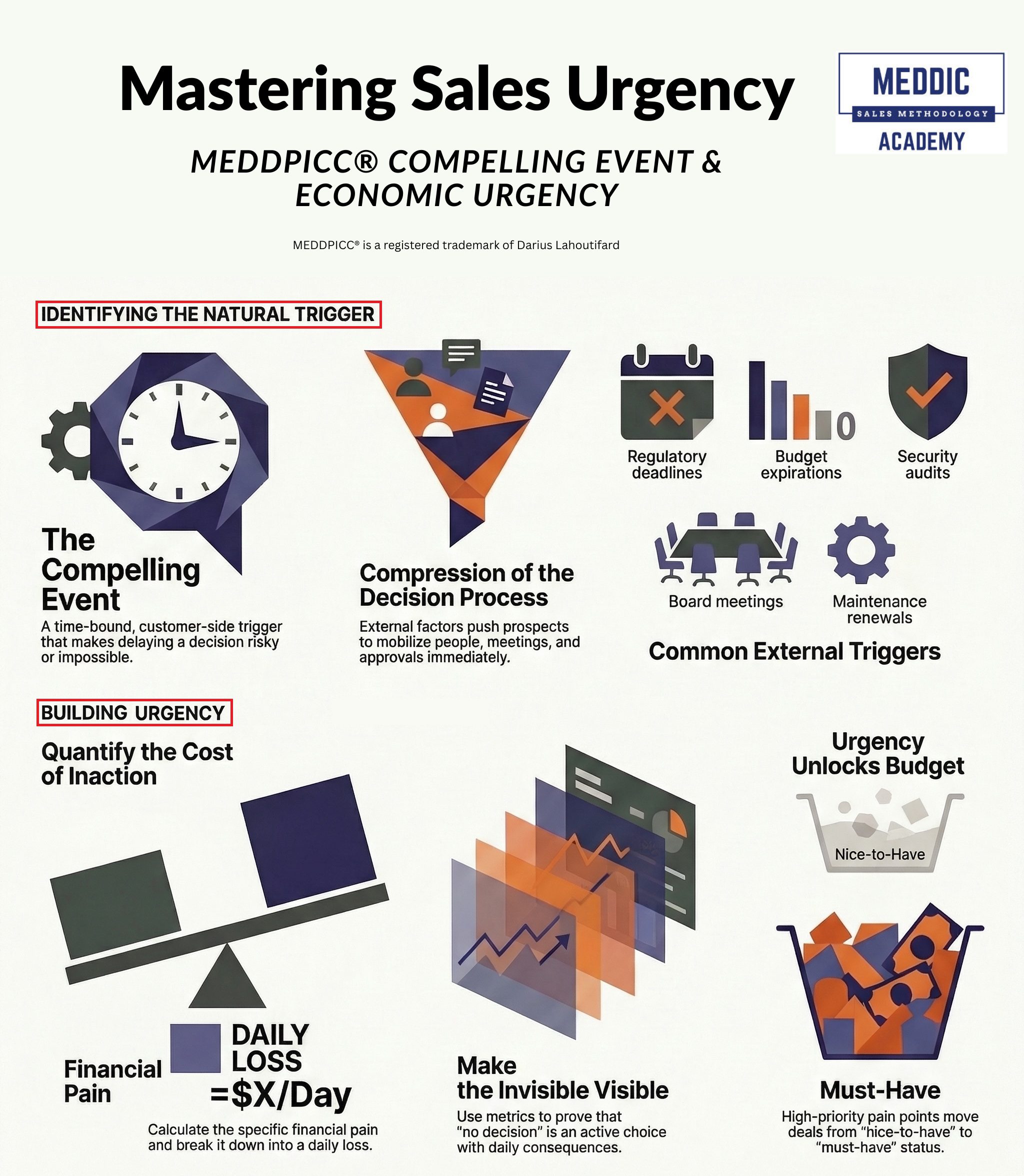
A Compelling Event is a time-bound business trigger that forces a decision.
It comes from the customer side, or from the outside world. It does not come from the seller’s quarter-end, forecast pressure, or wishful thinking.
A Compelling Event is something that makes delay dangerous, expensive, or impossible.
Examples are easy to recognize:
an expiring maintenance contract, a regulatory deadline, a security audit, a board meeting, a product launch, a plant go-live, the end of a budget cycle, or a customer commitment that cannot be missed (customer’s customer).
The key point is not just that a date exists. The key point is that the date carries consequences.
That is why a Compelling Event matters. It is not a calendar item. It is business pressure.
Why does a MEDDIC Compelling Event make a deal move faster?
Because it compresses the Decision Process.
When there is a real external or customer-driven reason to act, people show up faster. Meetings happen faster. Approvals move faster. Internal debates become more focused. Your champion has a stronger reason to rally support and push the opportunity through the system.
Without that pressure, deals often become polite theater.
Everyone sounds interested. Everyone is positive. Another call gets scheduled. Another email gets sent. Nothing truly advances.
A real Compelling Event changes the energy of the deal because it makes “do nothing” a costly choice.
That is why it is so valuable. It does not just help you forecast. It helps the customer make a decision.
Does no Compelling Event mean no deal?
No.
That is the lazy conclusion.
Not every serious opportunity begins with an obvious deadline. Some buyers have pain but have not connected it yet to urgency. Some companies are slow. Some problems are expensive but normalized. Some executives are living with avoidable inefficiency simply because no one has made the cost visible enough.
This is where real selling begins.
A strong seller does not just “find urgency.” A strong seller helps the customer understand why waiting is expensive.
So no, the absence of a Compelling Event does not automatically kill the deal. It means you need to do better work.
Is Timing a qualification criterion in MEDDPICC®?
No. There is no “T” in MEDDPICC®.
That point is worth repeating because a lot of sellers smuggle “timing” into qualification as if it were a formal pillar of the framework.
It is not.
Timing matters, of course. But timing by itself is not a MEDDPICC® element. Timing only becomes meaningful when it is connected to real Pain, measurable Metrics, internal Decision Dynamics, and a Champion who can carry the message.
If the customer is losing money every day, creating risk every week, or missing strategic objectives every quarter, then urgency may already exist even if nobody has put a deadline on the calendar.
In many cases, the problem is not the absence of urgency.
The problem is the absence of visibility.
What should a seller do when there is no obvious Compelling Event?
Create urgency the right way.
Not with manipulation. Not with fake scarcity. Not with “my manager needs this by Friday.”
You create urgency by quantifying the Pain and making the cost of doing nothing impossible to ignore.
That means moving the conversation from general discomfort to measurable business impact.
What is the economic impact of leaving the pain unremedied?
What is the pain costing the customer per quarter, per month, per day?
In other words, when you do not have a MEDDIC Compelling Event, create urgency to replace it. Quantify the Pain. Calculate the cost of doing nothing. Bring it down to a daily loss:
“Every day we wait, you are losing $X.”
That is how urgency becomes concrete. Urgency creates priority. Priority helps unlock budget. And when the buyer sees that delay has a measurable cost, the deal has a much better chance of moving forward.
When you do this properly, the conversation changes.
Now the buyer can see that waiting is not neutral. Waiting has a price.
And once the price of inaction becomes visible, urgency stops being theoretical.
Bonus point: They won’t ask for a discount. The reason for buying becomes avoiding losses, or risks or seizing revenue opportunities, not making the seller a favor.
How do Metrics create urgency when there is no deadline?
This is where MEDDIC becomes stronger than generic sales advice.
If Pain is real, it should be measurable. And if it is measurable, it can be translated into consequences the business understands: Dollars (or whatever the exchange is).
Let’s say the current problem is causing lost output, delayed revenue, poor conversion, avoidable churn, operational waste, security exposure, or compliance risk. Once those losses are quantified, the customer can no longer pretend that “maybe later” is harmless.
That is the bridge between Pain and urgency.
Metrics make the pain concrete.
Concrete pain creates urgency.
Urgency creates priority.
Priority attracts resources.
Resources unlock budget.
And then the deal becomes real.
That sequence is often more reliable than waiting for some magical deadline to appear.
Why Now?
At the end of the day, the real question is not whether you think the deal should move now. The real question is whether your Champion can convincingly explain to the Economic Buyer why the company should act now rather than later. That is where urgency becomes real.
Your Champion should be able to articulate a business case showing why buying now makes financial, operational, or strategic sense, and what happens if they wait. In other words, “Why now?” must have a credible answer. If the Champion cannot explain the cost of delay, the missed opportunity, the growing risk, or the business consequences of inaction, then urgency is still weak, even if everyone claims the deal is important.
Can you build a Compelling Event in a real sales process?
Yes, and good sellers do it all the time.
That does not mean inventing fake deadlines. It means helping the customer reach clarity.
A problem starts as vague frustration.
Then it becomes quantified.
Then it becomes visible to leadership.
Then it becomes tied to business outcomes.
Then it becomes a priority that needs a decision.
That is often how a Compelling Event is born.
So sometimes you find one.
Sometimes you build one.
You build it with discovery, with metrics, with consequences, with a champion who has credibility, and with a buyer who agrees that waiting is no longer acceptable.
That is not artificial urgency. That is professional selling.
Why do some sellers get this wrong?
Because “no Compelling Event, no deal” sounds tougher than it is intelligent.
It gives people the illusion of rigor. It lets weak sellers disqualify deals instead of doing the harder work of sharpening the business case. It also gives weak trainers a clean sentence to teach, even if it leaves sellers with a distorted understanding of MEDDIC or MEDDPICC®.
Sales is not about memorizing slogans.
Sales is about understanding what drives decisions inside complex organizations.
And in the real world, not every urgent decision begins with a visible deadline. Many begin with a seller who knows how to turn hidden pain into visible business consequences.
What is the practical MEDDPICC® takeaway?
A Compelling Event is a major advantage.
It helps deals move faster.
It helps your champion mobilize support.
It makes the Decision Process more urgent.
It makes “no decision” more costly.
But it is not always a mandatory starting condition.
If there is no obvious MEDDIC Compelling Event, do not panic and do not automatically walk away. Look deeper.
Is the Pain real?
Can you quantify it?
Can you express the cost of delay?
Can your champion carry that message internally?
Can the buyer see that waiting has consequences?
If yes, then urgency can still be created and the deal can still be highly qualified.
Some deadlines are discovered.
Others are built.
And that is exactly why MEDDPICC® is not a checklist for amateurs. It is a framework for serious sellers who know how decisions actually get made.
Sales urgency can be found with a compelling event, Or be created.
Learn more about MEDDIC and MEDDPICC by taking one of our courses.
FAQ: MEDDPICC® Compelling Event
No. A Compelling Event is highly valuable, but not every real has one. A qualified opportunity can still exist if the customer has real Pain, the impact is economic, can be measured financially, and urgency can be created through credible monetary consequences.
Timing is a general concept. A MEDDIC Compelling Event is a specific, time-bound trigger with business consequences. MEDDPICC® as an acronym, does not include a “T” for Timing. Timing only matters when it is tied to Pain, Metrics, Decision Process, and internal urgency.
A seller should not invent fake deadlines, but they can absolutely help build urgency by quantifying Pain, exposing the cost of delay, and helping the buyer see that waiting is expensive. In many deals, that is how a true Compelling Event emerges.
Common examples include contract renewals, regulatory compliance deadlines, board meetings, product launches, budget deadlines, plant go-lives, audit dates, strategic customer commitments, or any business milestone that forces a decision.
Do deeper discovery. Quantify the Pain. Calculate the cost of doing nothing. Bring the impact down to a monthly, weekly, or daily level. Help your champion use that logic internally. If the business consequences are real, urgency can still be created.
No. It is an oversimplification. A Compelling Event strengthens a deal, but the absence of one does not automatically disqualify the opportunity. Treating it as a rigid rule often reflects shallow selling or shallow teaching.
Because quantified Pain gives the buyer a reason to act. When the customer clearly sees the financial, operational, or strategic cost of waiting, urgency becomes real even without a formal deadline.
Yes. Many deals close because the business case becomes strong enough that delay is no longer acceptable, even if there was no obvious deadline at the start.